

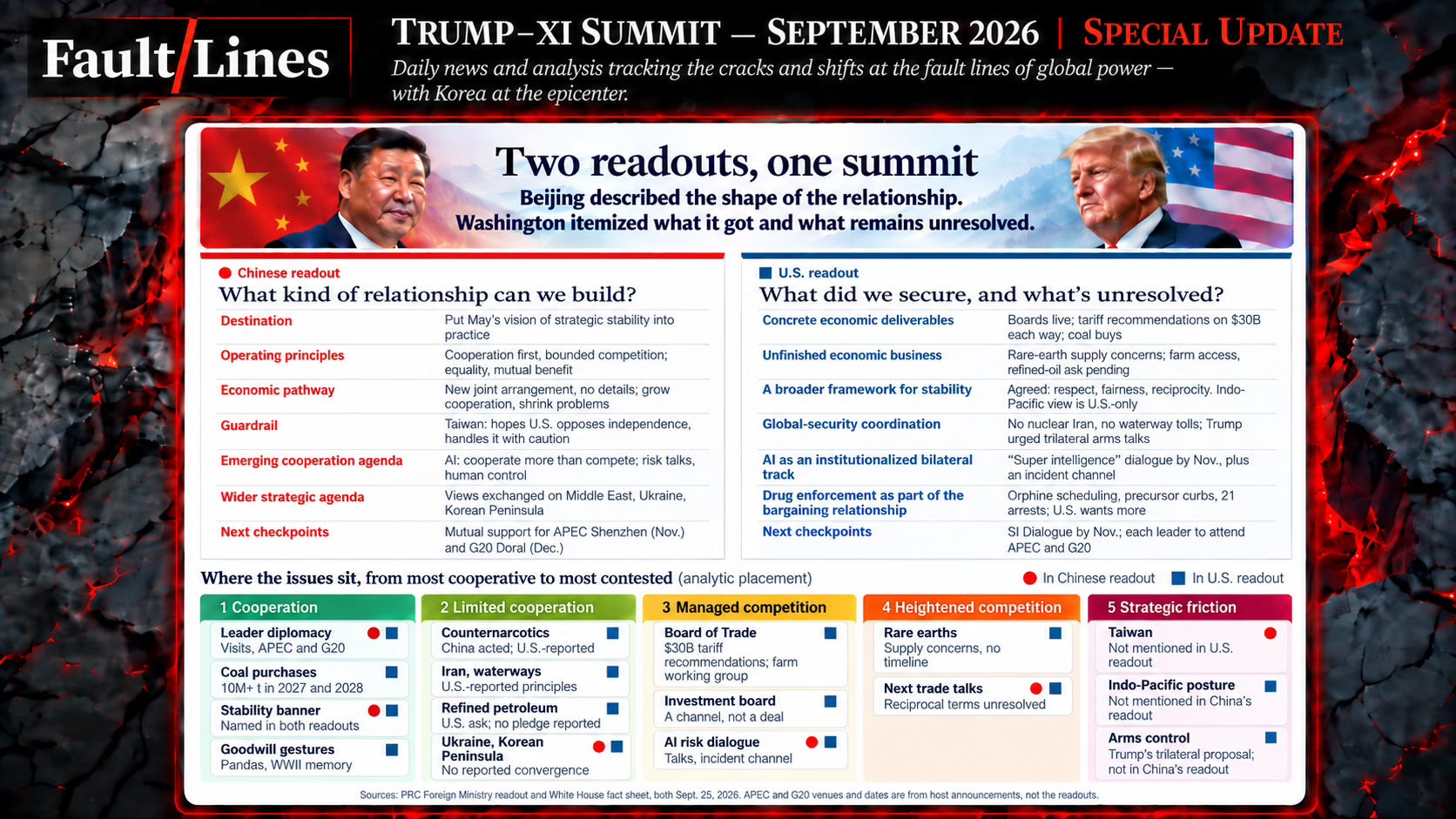
• Trump and Xi have moved U.S.-China relations into a more explicit framework of “strategic stability”—one designed less to end competition than to keep it bounded while creating room for selective cooperation. The three-day state visit produced more than the initial public messaging suggested. Washington and Beijing operationalized bilateral trade and investment boards; agreed on recommendations for more favorable tariff treatment covering $30 billion in nonsensitive goods each way; opened an agricultural market-access track; and agreed that China will purchase at least 10 million metric tons of U.S. coal in both 2027 and 2028. The existing trade truce was extended through January 10. On technology, the two governments established a U.S.-China dialogue on artificial intelligence—called “super intelligence” by the White House—and a bilateral channel for AI-related incidents, with another exchange expected by November. They also agreed that Iran should not acquire a nuclear weapon and that no country or institution should impose transit tolls on international waterways, an understanding directly relevant to continuing pressure around the Strait of Hormuz. But the summit did not resolve the deeper sources of competition. Rare-earth supply remains under negotiation; advanced technology and export controls remain contested; and Taiwan remains the clearest strategic fault line, with Xi urging Washington to oppose Taiwan independence while the U.S. readout records no new Taiwan agreement. North Korea, Ukraine and Russia were discussed, but no substantive convergence was announced. Trump and Xi are now expected to meet again at APEC in Shenzhen in November and at the G20 in Florida in December—turning this summit less into an endpoint than the opening of another negotiating cycle.
Sources: Yonhap News Agency — Trump, Xi agree to establish AI communication channel, oppose tolls on int’l waterways: White House; Yonhap News Agency — (5th LD) Xi says U.S., China reach new trade arrangement during summit with Trump: report; Seoul Economic Daily — Trump Says Xi Understands His Position on Taiwan; Nikkei Asia— Trump-Xi summit: How the Chinese leader's trip to Washington unfolded; The Japan Times — Xi seizes Trump detente to seek lasting gains on trade and Taiwan; Herald Business — Japan rattled by Trump's WWII 'allies' remark to Xi, moves to coordinate with Washington; The Korea Herald — China’s global ambitions, tech rivalry with US raise stakes for Korea; The Chosun Daily — Xi Concludes U.S. Visit, Trump Plans November, December Summits; The Chosun Daily — U.S., China Reject Iran Nuclear Arms, Waterway Tolls; Chosun Biz — Xi, Trump reset ties with superintelligence dialogue and maritime vow; The Chosun Daily — Trump, Xi Pledge Strategic Stability After Talks; Seoul Economic Daily — Xi Departs U.S. as Trump Touts "Tremendous" Talks Without Results; South China Morning Post — Xi-Trump Washington summit aimed at putting US-China ties on equal footing: Wang Yi; The Chosun Daily — People's Daily Hails Xi-Trump Summit as Key Step Toward Constructive U.S.-China Ties; Associated Press — Takeaways from Trump-Xi summit: Lots of pomp and even more punting on tensions in US-China relations; The Hill — 5 takeaways from Trump and Xi’s ‘Made for TV’ summit; CBS News — Trump-Xi visit wraps up with few achievements announced.
Primary readouts: PRC Ministry of Foreign Affairs — President Xi Jinping Meets with U.S. President Donald J. Trump; White House — Fact Sheet: President Donald J. Trump Advances a Fair and Reciprocal Relationship with China While Hosting Historic State Visit.
Impact:
For South Korea, the immediate significance of the summit is that Washington and Beijing are trying to stabilize the terms of strategic competition—and Seoul sits directly inside several of the sectors and security questions where that matters most.
Economically, a more predictable U.S.-China relationship focused on stabilization could reduce near-term risk to Korean trade and supply chains, especially if tariff tensions ease and critical-mineral flows become more reliable. But the competition is increasingly concentrated in areas where South Korea is itself strategically important: semiconductors, AI, batteries, advanced manufacturing and rare earths. Seoul therefore faces both opportunity and pressure as it tries to preserve technological competitiveness while navigating a more structured—but still intense—U.S.-China rivalry.
The Korean Peninsula, however, remains outside the summit’s main zone of cooperation. Trump and Xi discussed North Korea and the peninsula, but neither readout reports a common approach, new mechanism or substantive agreement. For Seoul, that means deterrence, diplomacy and alliance adaptation will continue largely on separate tracks from the broader U.S.-China effort to stabilize their relationship.
The summit’s Iran and Strait of Hormuz language is more immediately relevant. Trump and Xi agreed that Iran should not acquire a nuclear weapon and that no country or institution should impose tolls on international waterways. Given Seoul’s dependence on Middle Eastern energy flows and the pressure it has faced over Hormuz, even limited U.S.-China convergence on maritime access and energy stability could reduce one source of external pressure on the Korean economy.
The harder question is whether stabilization between Washington and Beijing changes the political space available to U.S. allies. Taiwan remains unresolved, technology competition continues, and Washington has separately reaffirmed the role of its forward military presence in the Indo-Pacific. Japan is already seeking closer consultation with Washington over what the summit does—and does not—mean for regional security. Seoul will need to make the same distinction between warmer U.S.-China diplomacy and any actual change in the strategic environment.
Seoul’s challenge heading into APEC is therefore to determine where U.S.-China stabilization creates room for maneuver—and where it does not: exploiting greater predictability in trade, energy and supply chains while preparing for continued pressure over technology, Taiwan, alliance posture and a North Korea problem that the Trump-Xi summit discussed but did not move toward resolution.